The Tube’s first awakening
The Character of RainThe Tube’s first awakening transforms a child whom adults have treated as nearly inert into a furious, moving presence. Its force lies in the reversal: after two years in which the specialists found no reflexes and the family called the child the Plant, a sudden fit of rage becomes the first unmistakable sign of life. The episode also establishes the narrative’s distinction between bodily development and the child’s own, previously unseen inward existence.
Background: A Life Misread as Inertia
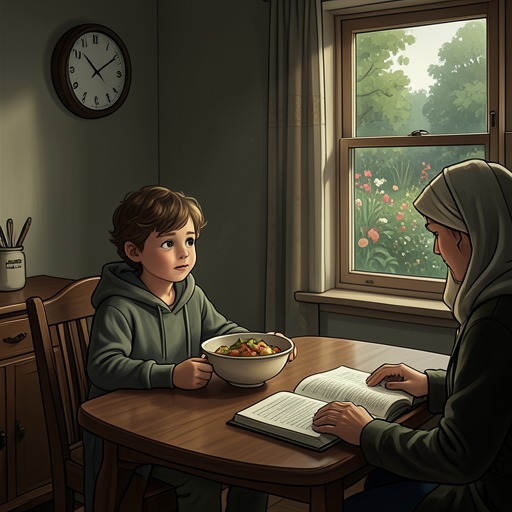
The specialists tested the child’s knees and elbows for reflexes and found none; shining light into the pupils did not make them move. The parents described a child who never cried, moved, or made a sound. The doctors called the condition pathological apathy, then declared the child a vegetable and recommended hospitalization. The diagnosis gave the parents unexpected relief: even a vegetable was still alive.
They did not follow the recommendation. Having two other children whom they regarded as full members of the human race, they could accept a third who seemed to belong to a different category; the condition even stirred tender feelings. They sweetly called the child the Plant. That name, however, repeated the adults’ mistake. The narration insists that plants are alive, though their life may be imperceptible to human eyes. The child’s apparent stillness likewise concealed an existence the family could not yet read.
By the age of two, the child had not tried to crawl, moved toward crawling, or made a peep. The parents, doctors, and nanny inferred a developmental blockage. They did not consider that the obstacle might be mental rather than physical, or that the child might in some sense have preferred to remain inert. The account places this misreading against its broader challenge to the idea that development must follow a necessary course: what adults call failure may conceal a different relation to action and change.
The Day the Child Sat Up
The awakening arrives on what initially seems an ordinary day. The parents behave like parents, the other children like children, and the child remains wrapped in its cylindrical existence. Then screams echo through the house. The Mother and the nanny hurry from room to room looking for their source; the Mother looks last in her own room. There, the child is sitting up in the crib and howling with the force of a two-year-old.
The change is visible in the child’s eyes as well as its voice. Until then, the wide-open eyes had been fixed in a stare, their gray-green color easy to identify. Now the pupils appear entirely black, like a scorched field. The narration leaves the cause of the transformation unexplained at first, but makes the child’s fury unmistakable: the child is seized by a tremendous fit of rage. When the fascinated Mother lifts the child, it kicks wildly, and she puts it down again.
The Mother runs through the house crying that the Plant is not a plant and calls for the Father. The brother and sister are brought in to witness the child’s fury. Eventually the howling stops, but the child’s eyes remain dark and its anger continues as it regards the assembled family. Exhaustion follows: the child lies down and falls asleep. The family applauds, overjoyed that the child has at last come to life. The day is treated as a turning point even though, like other pivotal moments in the account of human history, it passes without advance notice.
Explanations and Immediate Aftermath
The specialists cannot explain the sudden rebirth. They suggest that the child needed two full years of an extrauterine, womb-like existence before becoming operational. For the rage, they propose a mental event: something happened in the child’s brain that it could not accommodate, shaking the gray matter out of its slumber. Neural messages then began coursing through the nervous system, and the body began to move. This explanation leaves the initiating event unspecified, but shifts attention from a simple physical defect to an inward occurrence with bodily consequences.
The change does not make the child easy to care for. After awakening in rage, the child remains constantly enraged. The Mother or the nanny nearly has to throw a bottle into the crib and retreat before being struck. Quiet spells sometimes last for hours, but the adults experience them as calm before a storm. They use these intervals to take the child into the yard and set toys around it.
There the child gradually becomes upset by the toys’ independence: they exist outside the child and do not depend on it. The child also notices that the people around it make precise, articulated sounds with their mouths, and that these sounds somehow let them control and annex objects. Awakening thus opens onto a new difficulty. Movement brings the child into contact with a world that is not an extension of the self, while speech appears to offer a means of acting upon that separate world.
From Movement to Public Speech
The child later describes catching up on the expected milestones at two and a half. Walking comes first, through the unmagical sequence of standing, pitching forward, and shifting weight from one foot to the other. It improves the child’s view; running follows and makes evasion possible, allowing the child to take forbidden objects without being seen. The first public word requires a different kind of calculation. The child has been speaking inwardly, but must choose what to say aloud without revealing how much is already understood. The choice is Mama, a word that satisfies the parents’ need to hear their family roles confirmed while concealing the child’s private speech.
That distinction between inward and spoken language continues to shape the consequences of awakening. The child treats saying a word aloud as more than releasing a sound: public utterance gives it weight and recognition. While the parents believe that the first words mark the beginning of speech, the child has already been conducting an inner dialogue. Later, when trying to ask about death, the child regards the officially permitted vocabulary as limited to six words and struggles to move from that allowance to a thousand words without exposing the secret. Japanese and French are initially understood not as separate languages but as two versions of one great language, another sign that the child’s comprehension exceeds what adults hear.
The difference between private capacity and public speech becomes consequential during a drowning. The child first cries for help in Japanese; when the onlookers do not respond, the child screams in French. Hugo then hears the child speak, and the child admits to having been talking for a long time. The sea has forced a disclosure that the earlier choice of Mama had postponed. Against this later emergence of voice, the awakening remains the decisive bodily threshold: the child who had seemed absent becomes an agent who moves, perceives separation, and must decide what to reveal. The subsequent loss of the sacred status accorded to young children in Japan, and the anxiety the narrator associates with turning three, further complicate the change: coming to life is not a return to undisturbed innocence, but an entry into a world whose transformations the child can feel before understanding them.